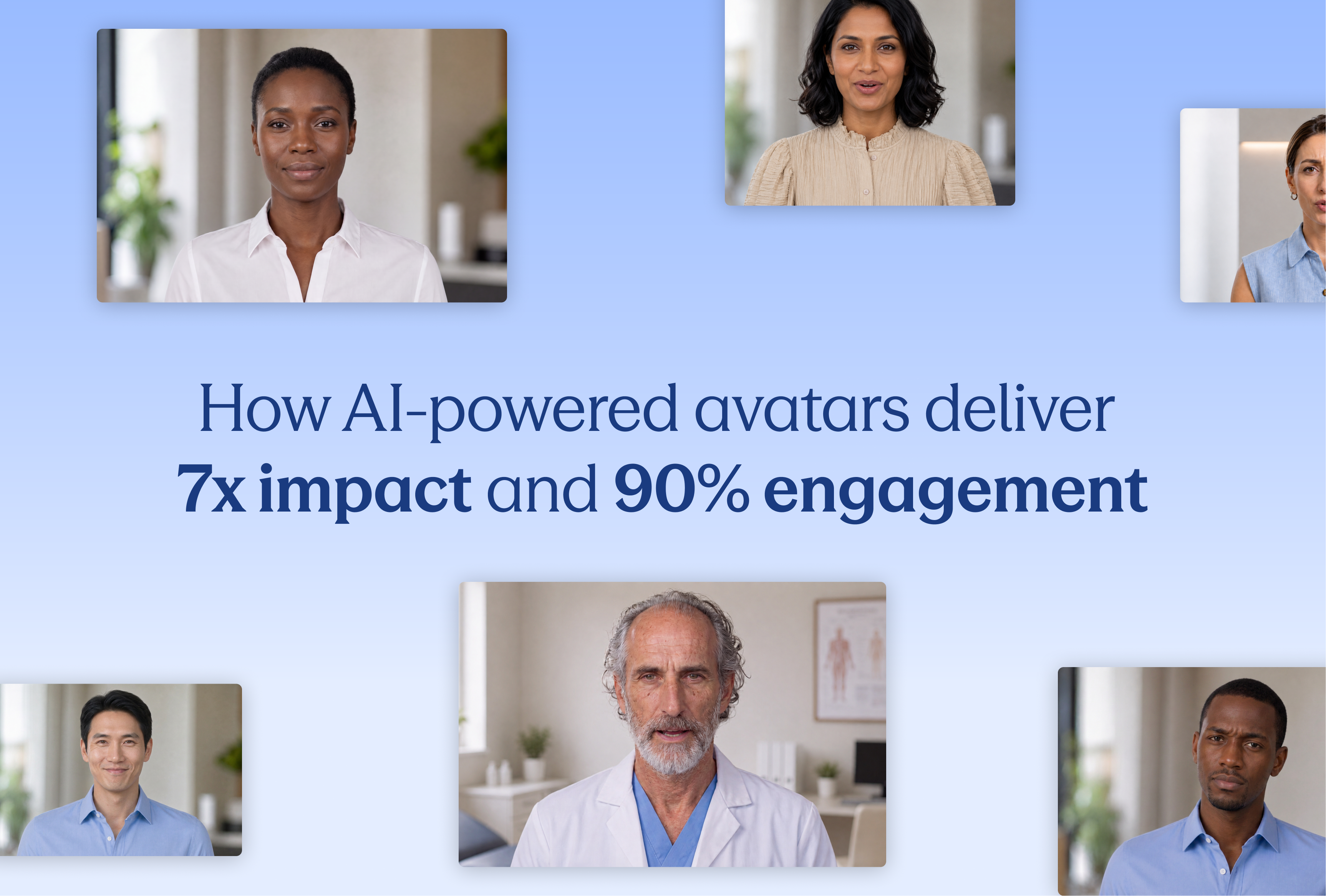
How AI-powered avatars deliver 7x impact and 90% engagement
Most AI in corporate training still just delivers content. AI avatars work more like a flight simulator for soft skills, giving teams a safe place to rehearse real conversations and measure what improves.
By Fara Rosenzweig March 18, 2026
This isn't new information. AI has entered the corporate training world. But it's a good reminder to reiterate that not all AI is created equal.
We hosted a webinar on how AI avatars are reshaping the way teams develop soft skills. The most effective AI doesn't just deliver content: it creates a space to practice.
Think of it like a flight simulator for soft skills. Just like pilots practice emergencies before stepping into a cockpit, employees can now practice real conversations safely, repeatedly, and with measurable outcomes.
Here's how AI-powered avatars make soft skills training dramatically more effective.
Key takeaways
AI avatars work best as a practice space, not a content delivery tool.
Scenarios built from real calls, real objections, and real personas make practice transfer to the job.
Learners in Rapport programs get 7x more effective practice, with over 90% staying actively engaged.
Conversation analytics show which skills need coaching, so managers spend time where it counts.
Humans stay in the loop: AI scales the practice, and people bring judgment and coaching.
Why practice beats content
Most corporate learning still assumes that if people understand a concept, they will apply it. Conversation skills do not work that way. Knowing that you should pause after a hard question is very different from pausing when a frustrated customer is talking over you.
Research on simulation backs this up. A meta-analysis of 145 studies on simulation-based learning in higher education (opens in new tab) found a large positive effect of simulations on complex skills, especially when learners received scaffolding and feedback. PwC's research on immersive soft skills training found learners were up to four times more focused than e-learners and 275% more confident (opens in new tab) applying what they learned.
Demand for these skills keeps climbing. The World Economic Forum's Future of Jobs Report 2025 (opens in new tab) ranks leadership and social influence, along with resilience, flexibility, and agility, among the skills employers expect to grow fastest in importance through 2030.
Engagement matters too. Gallup estimates that managers account for at least 70% of the variance in team engagement (opens in new tab), which makes the conversations managers have every week one of the biggest levers a company controls. Practice is how those conversations get better. For the deeper research on why this approach holds attention, read the science of engaging soft skills training.
Start with real-world data
Every organization's challenges are unique. Using real calls, real interactions, and real employee personas, companies can now build scenarios that reflect what their teams actually face:
Sales discovery calls
Customer escalations
Manager and employee feedback
Conflict resolution
Difficult client conversations
This becomes the foundation of high-fidelity training.
Bring scenarios to life through avatars
Rapport brings expressive, real-time 3D characters to life. They:
Listen
Respond naturally
React with body language
Adapt to what you say
Learners can even choose character styles that feel most comfortable, a key part of personalized learning.
What makes a high-impact avatar scenario
Not every AI conversation is useful practice. The scenarios that drive results share four ingredients:
A specific persona. A skeptical CFO, a first-time manager, or an anxious patient, with a clear personality and motivation.
A clear goal. The learner knows what success looks like, such as booking a next step or de-escalating a complaint.
A pressure point. The avatar raises the objection, emotion, or curveball that makes the real conversation hard.
A scoring rubric. Observable behaviors the learner is assessed on, so feedback is specific instead of vague.
Our step-by-step guide to designing an AI role-play scenario walks through each ingredient, and our explainer on live 3D AI avatars covers how real-time characters listen and respond.
Subscribe to our newsletter
Keep updated with Rapport and receive blog posts direct to your inbox
Practice anytime, anywhere
There's no setup required:
No scheduling trainers
No coordinating role players
No awkwardness
Learners simply open a browser, talk naturally, and practice as if they were on a real video call.
Measure what matters
This is where AI transforms training. With conversational analysis from partners like Relativ.ai, organizations can measure:
Key communication behaviors
Skill strengths and weaknesses
Confidence and emotional intelligence indicators
Engagement levels
Patterns across teams
This is what leads to outcomes like:
Metric | Result | What it means |
|---|---|---|
Practice effectiveness | 7x | Reps get 7x more effective practice than before |
Engagement | 90%+ | Over 90% of learners stay actively engaged |
Scale proven | 500+ | 500+ simulations completed to date |
Companies no longer guess which skills need work. They know.
Turn insights into action
Aggregated insights reveal powerful decisions, like:
Which skills need coaching
What new scenarios to build
How managers differ from individual contributors (ICs)
How performance varies across teams or regions
How training performance relates to business results
It becomes a true closed-loop learning system.
Where teams use AI avatar practice
Because scenarios are built from real situations, the same platform supports very different teams:
Sales. Reps rehearse discovery call questions, pricing conversations, and objection handling before they reach a live buyer.
Customer service. Agents practice calming upset customers and using empathy that sounds genuine.
Managers. New leaders practice giving constructive feedback, running one-on-ones, and handling conflict.
Leadership development. Senior leaders work through high-stakes moments in an AI leadership simulation.
Healthcare and life sciences. Teams rehearse sensitive conversations where the stakes are too high to learn on the job.
How to roll out avatar practice in 30 days
Week 1: Choose the moments. Pick two or three conversations where mistakes are costly or frequent.
Week 2: Build and test. Turn real calls and personas into scenarios, then run them with a pilot group.
Week 3: Launch with a goal. Ask each learner to complete a set number of practice rounds, not just one.
Week 4: Review the data. Look at which behaviors improved and which still need coaching, then add scenarios.
To estimate the payoff before you start, try our training ROI calculator.
AI doesn't replace humans (it elevates them)
A core message from the webinar: keep humans in the loop.
AI handles the scale:
Delivers scalable practice
Reduces training burden
Standardizes experiences
Surfaces insights
Humans bring the judgment:
Interpret nuance
Deliver high-level coaching
Apply empathy
Shape culture
This partnership is where real transformation happens.
Discover how to develop teams with AI avatars
See why thousands of creators trust interactive, human-like AI avatars for team growth, and how real-time analytics connect training to measurable outcomes at scale. Watch the webinar on demand.
AI avatar training FAQ
What is AI avatar training?
AI avatar training uses lifelike, real-time animated characters that listen, respond, and react with body language, so learners can practice realistic conversations and receive feedback on their performance.
Does AI avatar practice replace human coaches?
No. AI handles scale and consistency, while managers and coaches interpret nuance and deliver higher-level coaching using the insights practice generates.
What skills can teams practice with AI avatars?
Common use cases include sales discovery, objection handling, customer escalations, feedback conversations, conflict resolution, and interview practice.
How do you measure the impact of AI avatar training?
Track practice volume, scores on observable behaviors, and improvement over repeated attempts, then connect those trends to business metrics like ramp time, customer satisfaction, and retention.

Fara Rosenzweig, VP of Marketing
Fara Rosenzweig is the VP of Marketing at Rapport.
Related articles

What your LMS can’t show you about soft skills
Completion rates tell you someone clicked through a module, not whether they can handle a difficult customer. Here's how to measure real behavior change with scenario-based practice and reporting that stands up to a CFO's questions.
How to write a strong prompt for your AI avatar
Your avatar is only as good as the brief you give it, and vague prompts produce vague conversations. Here's how to set the scene with context, tone, and purpose so your avatar can think on its feet instead of reading a script.

The science of engaging soft skills training
You can't learn to swim by reading about water, and you can't learn hard conversations by watching a video. This is the learning science behind why passive training fails and what makes experiential practice actually stick.